"Aging, Dying and Living in the Anthropocene" is a thought-provoking conversation with Joan Tollifson that explores her perspective on embracing impermanence, facing mortality, and finding peace in uncertain times.
This conversation illuminates the profound paradox of our existence – that we can simultaneously acknowledge the potential extinction of our species while embracing the beauty of the present moment. Joan Tollifson offers a refreshing philosophical framework that reframes aging, dying, and ecological collapse not as tragedies to be feared but as natural processes that can spark awakening. She distinguishes between oppressive self-improvement driven by feelings of deficiency and genuine transformation that comes from accepting imperfection. By viewing humanity as "waves in the ocean" of consciousness, she suggests that our individual endings and even our collective ending as a species are simply part of a larger unfolding, inviting us to focus on how we respond to life's challenges rather than resisting inevitable change.
Practice viewing death not as tragic but as a natural transition
Recognize that personal and collective challenges can be awakening journeys
Focus on the present moment rather than future anxieties
Distinguish between necessary pain and optional suffering through perspective
Joan Tollifson's books:
Practice meditation to increase awareness of your reactions
Cultivate compassion for those who respond with fear or anger
Notice when you're caught in narratives of deficiency or self-improvement
Explore spiritual practices that help maintain presence during difficult times
Consider how you want to respond to societal and environmental changes
Join communities of like-minded individuals focused on awakening
Balance awareness of global challenges with appreciation for present joys
Practice holding paradox: acknowledging difficulties while finding gratitude
Reflect on mortality: Take time to consider your own views on death and how they influence your life choices. Shift focus from fear to acceptance.
Embrace life fully: Live with intention, recognizing that each experience, even the painful ones, is part of your spiritual curriculum.
Practice mindfulness: Engage in daily practices that help you be present, such as meditation or journaling, to stay grounded in the present moment.
Seek spiritual growth: Explore teachings from traditions that emphasize reincarnation and karma to deepen understanding of your life's purpose.
Create a balanced perspective: Avoid idolizing life or fearing death. Recognize both as parts of the same spiritual journey.
Contemplate your death regularly (for example, 5 minutes daily): This practice can help reduce fear and anxiety around death, making you more appreciative of life. Tip: Write in a journal.
Imagine your ideal deathbed: Envision the person you want to be at the end of your life and the experiences you want to have had. This can help you prioritize your values and live a more meaningful life.
Practice death meditation: Imagine the process of your own death, including the physical and mental changes. This can help you become more familiar with the idea of death and reduce its power over you.
Address unfinished business: Make an effort to resolve any outstanding issues, conflicts, or regrets in your life. This can help you live with a greater sense of peace and fulfillment.
Surround yourself with loved ones: Spend time with people who care about you and who make you feel loved. This can help you appreciate the preciousness of life and reduce feelings of isolation.
I do not fear death. I am tuning into the reality that I am dying. My body is sending me clear signals. You cannot change what is inevitable for all of us. But there is a peace in this knowing - it's like coming to the end of a long race and seeing the finish line. It's anti-climatic. Here we are at the end of our lives and it's bittersweet because it's all over. But at the same time, there's a sense of relief because it's finally complete. While there's a sadness because it's ending, there's also some enthusiasm for the unknown that follows. I do not fear the unknown, I welcome it with curiosity and hope. Will I remain in this world as a ghost? Will my soul find a new host? Will my awareness remain? Does everything simply stop? It's in accepting our fate that we will die that we can begin to live fearlessly. One common thread we all share is that we are born (the beginning), we live (the middle), and we die (the end). The beginning is over before you know it. You might have resisted it (like the baby who doesn't want to leave the womb), but if you're reading this, it's over. Where we exist - to the extent we are aware - is always in the middle. The end will come - and the closer it gets, the clearer we'll see it. Even if you die in an instant (most of us won't), it's likely you've know for a split second that you're about to die. Am I spending my life preparing for an end or embracing the moment - enjoying the experience of the here and now?
Note: In Sept-2021, I attended a 2-day retreat with Andrew Holecek. It was extremely beneficial, but I'm really thankful I had read his book before the retreat.
Onboarding for Death
Death 2.0 The goal of this retreat is to discover the pure awareness within that cannot die because it was never born. It's to make the unconscious, conscious. In the end, your force of goodness will take care of you. This is all you need to know.
Takeaways / WriterDowners
They are the tolls we pay on the path to the truth. They are the bedrock of Samsara. You can't avoid fear and anxiety, you can only move through it. During our mediation, you will stay with it Fear and anxiety can actually help us accelerate us on our path (read Pema Chodron). "Being a Buddha isn’t easy. It’s accompanied by fear, resentment, and doubt. But learning to leap into open space with our fear, resentment, and doubt is how we become fully human beings. There isn’t any separation between samsara and nirvana, between the sadness and pain of the setting sun and the vision and power of the Great Eastern Sun, as the Shambhala teachings put it. One can hold them both in one’s heart, which is actually the purpose of practice."
I'm reminded of the 'triathlete' phase of my life. It was when I crossed the finish line at Vineman that my 'tri life' ended. The experience was anti-climatic. My entire life revolved around achieving the goal, and once I achieved the goal, it was over. In a real sense, a big part of me died at the finish line. Q. Do I experience real grief for my own death?
What are the three types of dreams, and how can they relate to meditation and the nature of reality? The three types of dreams are:
Nightime
Daytime
The Bardo Between: When we transition from one dream to another. Q. Is it possible to meditate during a dream? If you find yourself in a lucid dream, what if you meditated? Would that take you to the true core of your being?
Moving from being reactive to being responsive by widing the spaces between dominos so that when one falls, the rest do not follow. Andrew provided a great visual using dominos. He showed how recognizing the bardos (the space between) can help us become more responsive and less reactive. It's Upaya: A vehicle of skillful means. Pause in the bardo (the space between thoughts/action). To move from impulsive/compulsive reactivity to a place of responsibility.
Always ask yourself (and the bardos is a great opportunity to do so): Is this the right view of the wrong view? It's having the skillful or expedient means to respond with the right view depending on the circumstances. It's about taking a course of action for the greater good. Ask: It's that action is applied with wisdom and compassion and that it is appropriate in its time and place. The same act that "works" in one situation may be all wrong in another. Upaya can help the stuck become unstuck and the perplexed to gain insight. The concept of upaya is based on the understanding that the Buddha's teachings are provisional means to realizing enlightenment (read the raft parable below). The Buddha compared his teachings to a raft no longer needed when one reaches the other shore. Upaya also refers to the Buddha's skill in shaping his teaching to be appropriate to his audience—simple doctrines and parables for beginners; more advanced teaching for senior students. Buddha's teachings as provisional, preparing the ground for the later Mahayana teachings (see "Three Turnings of the Dharma Wheel"). According to some sources just about anything is allowable as upaya, including breaking the Precepts. Zen history is full of accounts of monks realizing enlightenment after being struck or shouted at by a teacher. Skillful means is one of the major themes of the Lotus Sutra. In the second chapter, the Buddha explains the importance of upaya, and he illustrates this in the third chapter with the parable of the burning house. In this parable, a man comes home to find his house in flames while his children play happily inside. The father tells the children to leave the house, but they refuse because they are having too much fun with their toys. The father finally promises them something even better waiting outside. I have brought you pretty carts drawn by deer, goats, and bullocks he said. Just come outside, and I will give you what you want. The children run out of the house, just in time. The father, delighted, does make good on his promise and acquires the most beautiful carriages he can find for his children. Then the Buddha asked the disciple Sariputra if the father was guilty of lying because there were no carts or carriages outside when he told his children there were. Sariputra said no because he was using an expedient means to save his children. The Buddha concluded that even if the father had given his children nothing, he was still blameless because he did what he had to do to save his children. In another parable later in the sutra, the Buddha spoke of people going on a difficult journey. They had grown tired and discouraged and wanted to turn back, but their leader conjured a vision of a beautiful city in the distance and told them that was their destination. The group chose to keep going, and when they reached their real destination they didn't mind that the beautiful city was just a vision.
A man traveling along a path came to a great expanse of water. As he stood on the shore, he realized there were dangers and discomforts all about. But the other shore appeared safe and inviting. The man looked for a boat or a bridge and found neither. But with great effort he gathered grass, twigs and branches and tied them all together to make a simple raft. Relying on the raft to keep himself afloat, the man paddled with his hands and feet and reached the safety of the other shore. He could continue his journey on dry land. Now, what would he do with his makeshift raft? Would he drag it along with him or leave it behind? He would leave it, the Buddha said. Then the Buddha explained that the dharma is like a raft. It is useful for crossing over but not for holding onto, he said.
aka: The three Buddha bodies Our opportunity for liberation lies in the three bardos!
Dharmakaya: Formless - At end of bardo of dying - The unmanifested body of the law
Sambhogakaya: Ethereal form - During bardo of dharmata - The enjoyment (or bliss) body (sambhogakaya) is the celestial body of the Buddha to which contemplation can ascend.
Nirmanakaya: Form - During bardo of becoming - the physical form that appears in the world to teach us the path to liberation
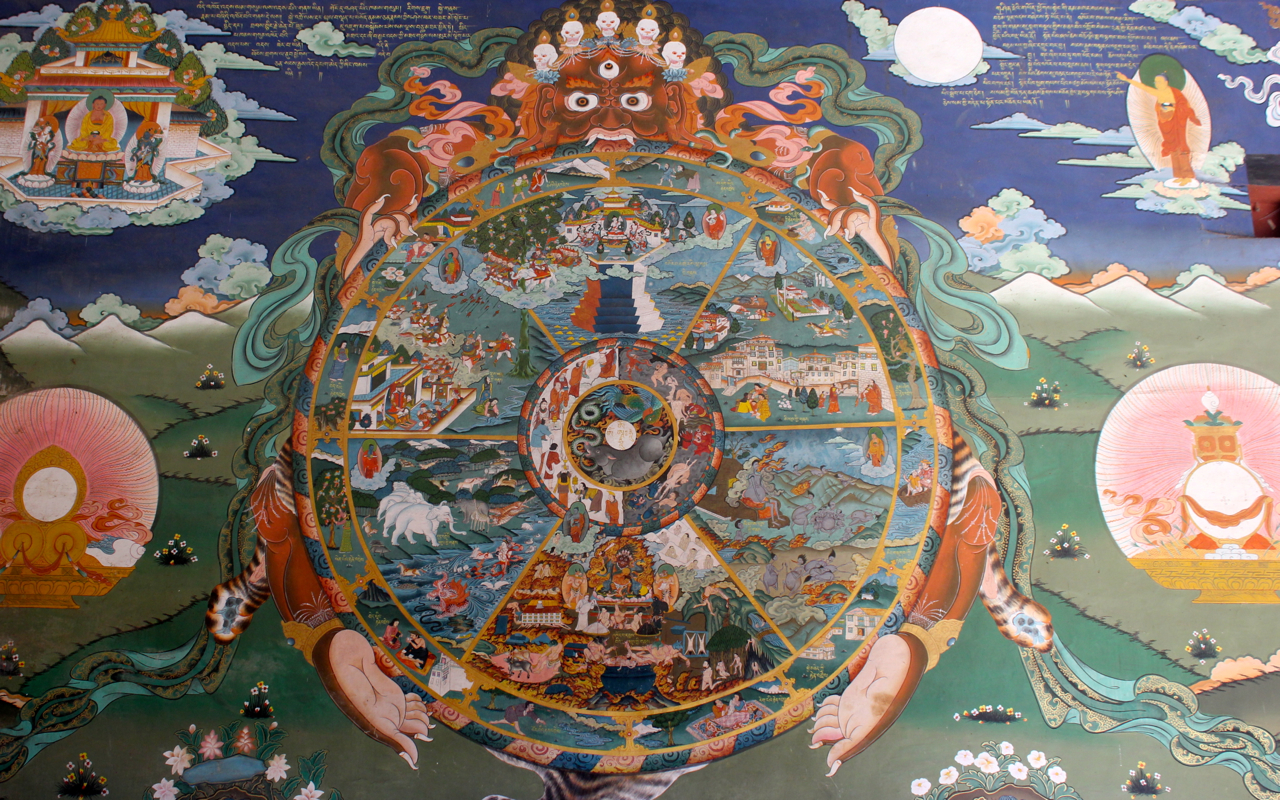
The Tibetan Wheel of Life Explained
Information (unembodied knowledge) Experience (embodied knowledge) We 'consume' wisdom in this way:
Hearing (ingest)
Contemplating (digest)
Meditating (metabolize) In today's world, contemplating is becoming a lost art. The goal is to literally become the teachings. Meditation is true knowing because it is rooted in experience. Words can never convey true experience as our experience is beyond thought. Mediation is non-conceptional knowing.
You cast no shadow
You look into a mirror but don't see your reflection.
You leave new footprints on sand or snow
Your body makes no sound
People don't respond to you
You can move through matter or fly (and might possess other miraculous powers)
You cannot see the sun or moon
All of life is held within the context of death. By acknowledging and preparing for death now, we will find ourselves living more fully and fearlessly. Join us as we celebrate the preciousness of life, and ready ourselves and others for this final journey. We will learn how to die a good death, and how to help others die, exploring meditations and contemplations that prepare us for letting go. As the Buddhist tradition proclaims “If you die before you die, then when you die you will not die.” With preparation, we can transcend death, turning the greatest obstacle into a once-in-a-lifetime opportunity, and even attain enlightenment. The bardo teachings lead to the death of death. The journey through the bardos is a journey into our mind, so by exploring the bardos we are exploring ourselves.
They also apply to any moment that ends – which means these teachings apply to daily life. Andrew's book Preparing to Die should be a prerequisite. “Unrecognized thought is the daytime equivalent of falling asleep. Each discursive thought is a mini-daydream. Drifting off into mindless thinking is how we end up sleepwalking through life—and therefore death.”
A Deeper Dive (Reading/Watching)
Watch The Lion’s Roar
The case against reality
Bernardo Kaspro
Consciousness Unbound
Quantum Questions
The 'Mind of Life' series
"Helgoland" - Carlo Reveli
Dreams of Light (Andrew Holecek)
Watch: Do Space and Time Really Exist? | Full Debate | Huw Price, Julian Barbour, Michela Massimi - YouTube
Watch: The Doom of Space Time (Dinner at the University of Oxford) - Nima Arkani-Hamed - YouTube
Read: Non-duality in Buddhism and Beyond
LivingWisely - Live your best life with insight and intention
There is a truth and it's on our side. Death is coming, it's time to open your eyes. Today I spent much of the day thinking about my own death. It was an especially very good day! What's that? I thought about who would be in the front row at my funeral. My VIPs. These are the people I love the most! And then I wondered whose funeral I'd like to be in the front row at. Why is the WeCroak app so popular? Because it relates to one thing we all share: Death. "Death is a psychologically threatening fact, but when people contemplate it, apparently the automatic system begins to search for happy thoughts." - Study result “You need to think about death for five minutes every day,” Ura replied. “It will cure you.” “How?” I said, dumbfounded. “It is this thing, this fear of death, this fear of dying before we have accomplished what we want or seen our children grow. This is what is troubling you.”
Death Clock
If you could know the exact day & time you would die, would you want to know? I know people say yes to when, but no to how. According to Death Clock, I will expire on Sunday, February 14, 2044. Depending on which death clock I believe, I'll either live till I'm 59, 67, or 81. The average age of someone like myself is 81 years.
Reincarnation
Because Buddhists believe in reincarnation, they say you shouldn’t fear dying any more than you fear discarding old clothes.
Is Life Heavy?
Does life ever feel like a burden? Are you carrying the weight of the world on your shoulders? Why contemplate death? Because it's the alternative to life. There is no partial living. You are either alive or your not. There is the idea of not living fully, but that's not the same as being dead. Find happiness by contemplating your mortality with the WeCroak app. Each day, we’ll send you five invitations at randomized times to stop and think about death. It’s based on a Bhutanese folk saying that to be a happy person one must contemplate death five times daily. The WeCroak invitations come at random times and at any moment just like death. When they come, you can open the app for a quote about death from a poet, philosopher, or notable thinker. You are encouraged to take one moment for contemplation, conscious breathing or meditation when WeCroak notifications arrive. We find that a regular practice of contemplating mortality helps spur needed change, accept what we must, let go of things that don’t matter and honor things that do.
Going Further (Reading/Watching)
A Beginner's Guide to the End: Practical Advice for Living Life and Facing Death
The Art of Dying Well: A Practical Guide to a Good End of Life