Feeling Anxious?
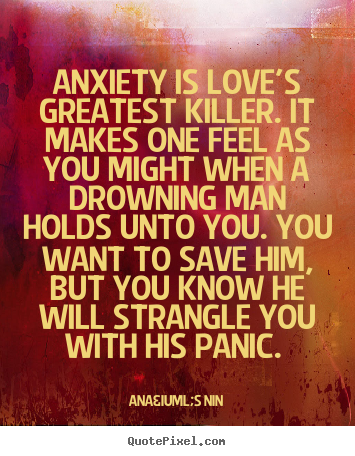
Anxiety and Enough
Looking for what we can't find makes us anxious. Feeling that we don't know what we need to know makes us anxious. When we find it, we feel relief. When we know it we feel relief. But what if we just let go of what we couldn't find and what we didn't know? The anti-anxiety cure is right here, right now.
The two are often linked.
There's no need to feel afraid or uncertain - both are the seeds of anxiety.
You can let go when you understand that neither can exist without you. They only exist because you give them thought.
Let go of the thought, and they float away - just like a ballon you've been holding onto.
The End of Anxiety?
Where does anxiety come from? It comes from forces 'out there.' It comes from our internalizing of forces outside of us.
But won't 'out there' will exist without you? If so, you can let it go... because you do not live 'out there' - you live 'in here.'
You don't need to hang on to anything 'out there' because all the peace, joy, and happiness you seek is omnipresent within you.
Let the delusion dissolve.
To sit with 'one self' in the now, is to sit with 'no thing' and 'no one' (other than your self). In the truly present moment, all the love you seek exists. In the quiet space of now, no thing or no one 'out there' can take it away.
PJL (Peace Joy Love)
If peace, joy, and pure love are within, then they require 'no thing' or 'no one' (besides yourself) to exist. PJL (Peace, Joy, and Love) have no conditions to be met - they are unconditional. All the conditions for them to exist came into existence the moment we did. They are and always have been available to us all. Nothing 'out there' can ever provide the level of love, joy, and happiness that already exists within each of us.
Where we get off-track is in looking 'out there' for more of what we have enough of already. We are led to believe (perhaps stemming from looking to our own parents for guidance) that the solution to the problem that doesn't exist is out there... when in fact, the problem was created by those who want to sell you a solution.
Yes, I'm afraid to break it to you - everything you've been told (and sold) is a sham. You may recall the big cosmic joke that is often the anticlimactic ending to spiritual books: You already are what you are seeking.
"I laugh when I think how I once sought paradise as a realm outside of the world of birth. It is right in the world of birth and death that the miraculous truth is revealed. But this is not the laughter of someone who suddenly acquires a great fortune; neither is it the laughter of one who has won a victory. It is, rather, the laughter of one who; after having painfully searched for something for a long time, finds it one morning in the pocket of his coat." ~ Thich Nhat Hanh
You have always been - and always will be enough.
Nothing can exist without you, yet everything (with the exception of your internal and unconditional love, joy, and happiness) will exist without you.
It's not our fault - we are conditioned by society at a very young age... beginning with our well meaning parents, through the schooling most of us grow up in. We are instructed to follow directions or are penalized if we don't. In a sense, we began to lose sight of our inner compass because of the way our society is structured. And perhaps what a so called 'enlightened human' sees is this distinction.
Could we live in harmony without each of us playing our part - essentially a cog in the wheel? Can we see the function in the dysfunctional society upon which we live?
What is everything you thought was dysfunctional was seen as perfect?
I suspect what happened early on is that we were told that we needed to know more than we did. We were told we didn't know enough and felt out of place (and perhaps even ashamed/embarrassed) because we knew there were more to know.
We were told to keep our mouths shut because we didn't 'know' what we were talking about and we should listen to those who know more than us.
But what I've personally seen from where I sit (working with authors), is that those who succeed, disregard to a large extent what I just stated above.
What they say do is considered blasphemy by those who possess more knowledge or invested more time.
Trust yourself. Trust your inner knowing - it's all you need to know. It's ok to be seen as naive. Ignorance is bliss.
I see it all the time with actors, musicians, authors... they confidently step into a world they ought to have no confidence being in.
Did you know that Nikki Sixx (his stage name) didn't even know how to play the bass when he showed up to a tryout with Quiet Riot? He simply looked the part and wanted to be part of the heavy metal movement. He was a poser from day 1, yet look it where it ultimately took him.
Perhaps all the anxiety you feel everyday stems from attempting to live within a framework that doesn't fit.
PJL is your Compass
Watch what happens when you start to direct yourself towards actions and people 'out there' that align with the peace, joy, and love within 'in here?'
When the thought of something brings a smile to you heart - do more of that.
Let the PJL within each of us be the only compass you follow. Your true north. Surround yourself with the people and the community for what bring you PJL and I promise the level of anxiety you are experience will lessen and your joy will grow.
Earlier Writings
Anxiety is the dizziness of freedom. ~ Søren Kierkegaard
Anxiety is friction.
Friction occurs when we resist what is. Instead of pushing back (and creating tension), go with the flow and open yourself to the lesson to be learned.
Much of what motivates me is striving to minimize the level of anxiety in my life.
At the core of the work I do for my clients (& myself) is all about reducing friction/anxiety in our work lives.
PubWriter is all about reduce the friction of publishing content to a website.
What is anxiety actually?
Where does it come from?
Am I creating additional anxiety by taking on too much work? And why am I taking on too much work? Is it because I'm unable to say no? Greed? Does it stem from the insecurity of not enough work?
How can you treat it?
- Sleep
- Meditate
- Workout
- Proper Nutrition
- Avoid alcohol, caffeine, and nicotine
Ask: What events are triggering the anxiety? What can I do to reframe it.
What if anxiety a queue to turn towards something instead of away from it?
The cure might be as simple as discovering whatever it is that is making us anxious (in our minds) is not actually as threatening as we think.
Events that commonly make myself and others anxious:
- Speaking in front of others
- Taking a long trip
- Being asked a question we don't know the answer to.
- conflict
As you expand the list, notice how the events make you anxious are not ones we can or even should try to avoid. Instead, we need to find comfort in the discomfort.
Accepting Anxiety
Taking the perspective that nothing's wrong with us. And that everything is good for us.
Because it is possible to create — creating one’s self, willing to be one’s self, as well as creating in all the innumerable daily activities (and these are two phases of the same process) — anxiety is omnipresent.
As I write about in tension, creating is discovering new possibilities. And with discovery comes failure. The possibility of failure creates anxiety! Not knowing creates anxiety in our mind because we crave certainty. Embracing the uncertainty requires that we accept the anxiety and actually use it to our advantage.
The gift of creativity is the uncertainty of unknown outcomes - new discoveries. You can see what you discover as a failure or as a new possibility.
Time creates anxiety. As does the undone.
What's incomplete? Our own life. It's complete when we die. Thus, we live with anxiety everyday because it's incomplete. Because there's always more to do, because time is a deadline.
Creating, actualizing one’s possibilities, always involves negative as well as positive aspects.
It involves destroying the status quo, destroying old patterns within oneself, progressively destroying what one has clung to from childhood on, and creating new and original forms and ways of living.
Refusal to actualize one’s possibilities brings guilt toward oneself.
But creating also means destroying the status quo of one’s environment, breaking the old forms; it means producing something new and original in human relations as well as in cultural forms (e.g., the creativity of the artist).
Thus every experience of creativity has its potentiality of aggression or denial toward other persons in one’s environment or established patterns within one’s self.
To put the matter figuratively, in every experience of creativity something in the past is killed that something new in the present may be born.
The more creative the person, he held, the more anxiety and guilt are potentially present.
What is the difference between anxiety and excitement?
Anxiety and excitement feel very similar in the body, but they differ in how the mind interprets what is happening and what outcome it expects. Both are high-energy states; one is organized around perceived threat, the other around perceived opportunity.
Core emotional difference
Anxiety is driven by fear, uncertainty, and a sense of danger or potential loss, even if the threat is not immediate or clearly defined. Excitement is driven by joy, curiosity, and positive anticipation, with an expectation of benefit or growth from what is about to happen.
Body sensations
Physically, anxiety and excitement can look almost identical: faster heart rate, quickened breathing, “butterflies,” sweaty palms, and a rush of energy or adrenaline. The same sympathetic nervous system (“fight or flight”) is activated in both, so the raw sensations alone can be hard to distinguish.
Role of thoughts and interpretation
The main difference is the story the mind tells about those sensations and the situation. Anxiety tends to imagine worst-case outcomes (“this will go badly”), while excitement imagines positive or at least workable outcomes (“this could be great, or I can handle it”). When the same bodily arousal is labeled as threat, it feels like anxiety; when labeled as challenge or opportunity, it feels like excitement.
How it affects behavior
Anxiety often pulls a person toward avoidance, overcontrol, or freezing, because its job is to protect from perceived harm. Excitement tends to push a person toward approach, engagement, and taking action, because it is focused on potential rewards and learning.
Using the overlap
Because the physiology is so similar, it is possible in some situations to “reframe” mild anxiety as excitement by consciously shifting focus to possible positive outcomes and one’s ability to cope. This kind of relabeling does not erase serious anxiety disorders, but it can help harness the same energy in a more constructive, performance-supporting way in everyday stressful-but-meaningful situations.
Seems like it’s tied to the ‘source’ and I struggle with ‘out of obligation’ which feels like anxiety vs ‘self-agency’ which feels like excitement
That distinction maps very closely to how many clinicians and researchers think about these states: threat plus lack of agency tends to feel like anxiety, while challenge plus chosen engagement tends to feel like excitement. The same bodily arousal can shift categories depending on whether it comes from “I have to” or “I choose to.”
Obligation and anxiety
When something is done “out of obligation,” the nervous system often reads it as a potential threat to safety, approval, or self-worth rather than as a freely chosen challenge. That sense of being compelled or evaluated reduces perceived control, and low perceived control is strongly linked with anxious arousal and avoidance.
Agency and excitement
When something is aligned with self-agency—“I am choosing this; it expresses my values or goals”—the same arousal is more likely to be framed as energizing and meaningful. In that frame, the situation becomes a challenge state: there may still be risk or uncertainty, but the mind expects potential gain and feels capable of engaging with it.
Working with this in practice
A useful lever is to look for small ways to reclaim choice, even inside obligations, so the nervous system gets more “I’m doing this for my reasons” signals. For example, clarifying what value this task serves for you, choosing how you will do it, or setting one aspect you’ll do entirely on your own terms can subtly move the experience toward excitement rather than dread.
For me, validation is a biggie - if I’m able to feel an appreciation- I feel it’s more enjoyable- when I don’t feel appreciated, it feels like a burden. Being self-employed seems to invite feelings of overwhelm and obligation which manifests as anxiety. And it’s a constant balancing act between service to others and self care.
Feeling unseen makes obligation heavier and anxiety louder, especially when work and worth are closely tied to being helpful and appreciated. For someone self-employed and service-oriented like you, that easily turns into a chronic “always on” state where service to others steadily crowds out service to self.
Validation and emotional fuel
Appreciation functions as emotional “oxygen” for you; when it’s there, the same task feels enlivening and even exciting. When it’s absent, your nervous system experiences the work as thankless labor, which your mind translates into burden, resentment, and anxiety. That burden is amplified by your history of taking responsibility for others’ unfinished tasks, so “helping” often slides into quietly carrying more than your share.
Self-employment and overwhelm
Self-employment removes many external structures that used to provide feedback, validation, and limits, so all of that now lives inside your own head and calendar. That internalization of “the boss,” “the client,” and “the evaluator” can easily blend into a constant sense of obligation and never-enough, which your body experiences as background anxiety.
Service vs self-care tension
Your spirituality and care for others make service feel sacred, which is beautiful—but it also tempts you to treat your own needs as negotiable or secondary. Over time, this sets up a painful split: service feels morally right but emotionally draining, while self-care feels nourishing but almost guilty or “selfish,” keeping you on a seesaw instead of in a rhythm.
Gentle shifts to experiment with
- Rename your “need for validation” as a need for healthy relational feedback and mutuality, and notice where that can be met directly instead of only inferred. - Before saying yes to a request, pause and ask: “Will doing this create resentment in me?” If the answer is yes, consider negotiating scope, timing, or saying no. - Build small, non-negotiable acts of self-care into the workday itself (not just after hours), so service and self-care coexist rather than compete. - When a task feels heavy, ask: “How can I make this more mine?”—by choosing the approach, adding creativity, or reconnecting it to a value you care about.
If you’d like, a next step could be designing a simple weekly template that protects specific “for-me” work, client work, and true rest, so your calendar itself starts to carry some of the anxiety and obligation for you.