Hot Seat
Ask Me Anything LIVE
Where everyone who attends becomes the center of attention.
It allows you to tap into the mind of the most successful individuals in your industry. The format engages attendees unlike any other, and reveals new truths. It allows for originality with unexpected results.
The hot seat floods the VIP with a wave of appreciation and allows attendees to see new possibilities for themselves.
What if others in your company adopted some of the beliefs of the top performers in your company or industry? Excellence can be contagious. You just need a medium to begin the flow. Hot Seat is that medium.
The Hot Seat is an ingenious strategy to generate new buzz for your organization or event.
If you run a conference, have you ever considered the potential impact of having a big name associated with your event? This unique format provides something different that appeals to anyone.
The model allows attendees to engage more deeply and removes the intimidation by providing them with a list of questions to ask the VIP.
Part 1 - Attendees are put on the hotseat
There's two high chairs, our 'VIP' is in one. I begin by formulating a list of questions in advance (see sample below) - they are printed out for the VIP.
The VIP draws a name of one attendee who sits in the hot seat. The VIP then asks one question from the list (or comes up with their own).
The first part of the event is not what attendees expected. But it allows for two important elements:
- It gives the VIP time to formulate his own best answers
- It creates a closer (intimate) connection between the VIP and the attendees.
You feeling is like a fireside chat or coffee shop.
New truths are revealed because the person in the hot seat hasn't been prepped with the question in advance. The first thing we say is often closer to the truth. The process taps into the collective wisdom of the audience and engages them in the event. You might be surprised to find that Bill in accounting is a hidden genius within your own company!
In Part 2 of the event, the VIP is put on the hotseat.
But rather than the typical Q&A being asked from one person, the VIP continues to draw names and those called get to step up on stage and as the questions now. The tables are turned, but now the answers come from the master in the room.
Each person who is drawn has the option to ask the VIP a question or formulate their own question.
Having the VIP go second is key. It's to prevent their answers from impacting answers given by the attendees and gives the VIP more time to think about the questions they might be asked (since they were the one asking the questions in part 1). It's extremely impactful because when we hear the VIPs answer, we see a clearer distinction of how it contradicts (or is similar) to the attendees answer - and it becomes more relatable (and memorable).
We'll record the event and it will become a cherished artifact. I'm amazed at what new truths come out, but more meaningful is the connection the audience feels with the VIP. I've seen it turn envy into admiration.
Example
These are questions I had formulated when we had Jay Asher was in the hotseat at a recent event. Questions related to the craft of writing:
- Where do the ideas for your books come from?
- What do you think makes a good story?
- Do you write by pen or by computer? If computer, what program do you start with?
- Any tech tools that have become part of your process?
- Where do you do most of you writing?
- Do you submit to a critique group or an editor? Is anyone providing ongoing feedback?
- Have you attended a writing retreat or ever slipped away to write?
- When do you know your work is ready for an editor?
- Why do you write?
- What has been your greatest obstacle (in writing) & how have you overcome it?
- Have there been some specific books or classes that have really helped?
- Explain the process (workflow) of something you recently wrote for publication.
- Who (or what) were the early influences on your writing and how do they show up in your work?
- How has your writing changed who you are and how you see the world?
- What are you writing now?
- When did you first realize you wanted to be a writer?
- How long does it take you to write a book?
- What does your daily schedule look like when you're writing?
- What would you say is an interesting writing quirk?
- When did you write your first book and how old were you?
- What do you like to do when you're not writing?
- What was one of the most surprising things you learned in writing your books?
- How many books have you written? Which is your favorite?
- Do you have any suggestions to help me become a better writer?
- Anything I haven't asked that you think I should have?
- As a child, what did you want to do when you grew up?
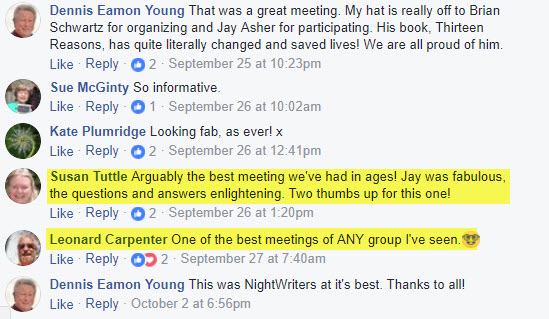
The result of this unique format was a more an intimate event that many attendees reported as one of the best meetings they had ever attended.
Because the names are randomly drawn, it tends to catch people off guard so they can drop any personal agenda they might have.
Also, these events are often done as a surprise. You can keep the name hidden from attendees, but pique interest framing it as a special event (since it's unlike any format you've done before). As people enter the event, they write their name on a slip of paper, but are not told the reason why.
Contact me to discuss how I can bring the HOT SEAT format and make your next event amazing for your attendees!
My best,
Brian Schwartz
805-225-1251
Comments from Facebook: