Embrace Embarrassment
AKA 'Feeling Awkward'
Related to: humiliation, shame, awkwardness, discomfort.
Triggered by: an event (or person) causing embarrassment, being caught in an awkward situation.
Resistance: Being seen without our mask
"Move out of your comfort zone. You can only grow if you are willing to feel awkward and uncomfortable when you try something new." - Brian Tracy
What the hell do I have to be embarrassed about? EVER?
I have always admired those who don’t care about what others think. They are authentically who they are, unfazed by the opinions of others. They live by the mantra: The opinions of others need not be my concern.
OPOs (Other Peoples Opinions) are just opinions, most of which are based on no evidence. For every negative opinion, there’s a positive one. I'll never please everyone, so why try? In the end, what matters is that I stay to true to my mission, whether or not there's any embarrassment along the way.
I am careful not to form opinions of others, as doing so is a precursor for judgement. I know it's difficult not to have an opinion, so I'm advised to remember that my opinion is subject to change.
I know that awkward feeling (and it hit me early today as I was doing yoga) is a good thing. It's an indication I've stepped out of my comfort zone. I've pushed my edge and it'll never return back. The more I do yoga in public, the less I'll be phased by the reactions of others.
Pushing your edge
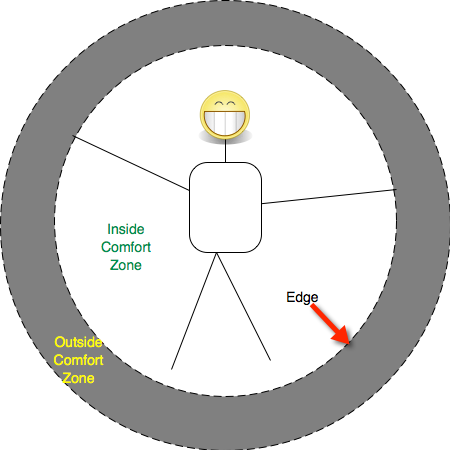
Fear of embarrassment can be one of the most powerful forces pulling a person away from an authentic life. It makes us edit ourselves in advance: we do not ask, make, say, wear, try, publish, or begin because we imagine the moment of being judged.
Embarrassment is not necessarily a “wasted” emotion or something you must overcome before being yourself. It is a normal social alarm—an involuntary reaction to the possibility of losing standing, approval, or belonging. The problem begins when avoiding that feeling becomes the organizing principle of your life.
The key distinction
There are two very different goals:
| Goal | Likely result |
|---|---|
| “I must get rid of embarrassment.” | More self-monitoring, more struggle, often more embarrassment |
| “I can allow embarrassment and still do what matters.” | More freedom, practice, and authentic expression |
Trying not to feel embarrassed can paradoxically make you more preoccupied with how you appear. You start scanning: Did that sound foolish? Are they judging me? Did I reveal too much? The attention turns inward, and the imagined audience gets larger.
A Morita-like response is simpler: Of course I feel embarrassed. I am a social creature, doing something exposed. Now, what is the appropriate next action?
Authenticity is not fearlessness
An authentic life does not require becoming indifferent to other people. Social awareness, tact, and the ability to revise yourself are valuable. The issue is whether you are choosing your behavior based on your values and the situation—or reflexively avoiding anything that could make you look foolish.
For a writer, that might mean:
- Publishing a piece that is genuinely yours rather than endlessly softening it to avoid criticism.
- Asking for an opportunity, testimonial, or introduction despite feeling presumptuous.
- Sharing an unfinished idea in a workshop.
- Naming a price for your work without apologizing for it.
- Letting a creative experiment be imperfect, niche, or possibly misunderstood.
The authentic act may still produce embarrassment. But it also produces evidence: you survived, the feeling passed, and the feared social catastrophe was usually smaller—or less consequential—than anticipated.
A practical stance
When embarrassment appears, try this sequence:
- Name it plainly: “This is embarrassment,” or “I am having the urge to protect my image.”
- Do not litigate it: Avoid spending ten minutes determining whether the feeling is justified, irrational, or permanent.
- Identify the real task: What needs to happen here—speak honestly, send the message, ask the question, make the call, set the boundary, perform the song?
- Take the smallest complete action: Press send, say the first sentence, make the request, post the draft, enter the room.
- Let the feeling accompany you: The goal is not emotional victory. The goal is participation in your life.
A useful replacement for “Don’t let embarrassment stop me” is:
“Embarrassment may come along, but it does not get to decide.”
The nuance
Not every inhibition is false or cowardly. Sometimes embarrassment is information: perhaps you violated your own standards, spoke carelessly, or need to repair something. In those cases, authenticity includes accountability—apologize, learn, and continue. But embarrassment that arises merely because you were visible, earnest, inexperienced, unconventional, or honest is different. That is often the price of entering the arena rather than watching from the stands. The question is not whether you can eliminate the fear of embarrassment. It is whether you are willing to be briefly seen as imperfect in exchange for actually living the life you mean to live.