The Neurotic's Guide to Avoiding Enlightenment
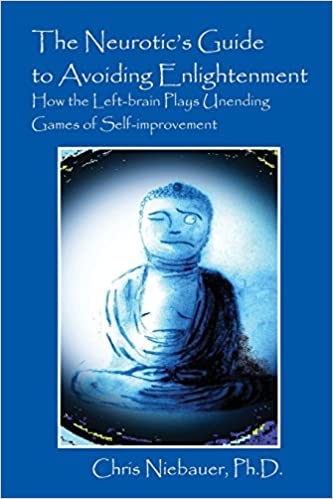
How the Left-brain Plays Unending Games of Self-improvement by Chris Niebauer Ph.D.
New insights
This moment is the most important one because it's the only one we directly impact. We are the most important part of every moment because we are a vital part of it, as are the other people in this moment. In this moment, we are equally important, because it doesn't exist without us.
The people we share it with are the most important people in that moment.
In yoga: This is the most important class because it's the only class I'm actually in.
In a nutshell (Synopsis)
A new point of view: What happens when you go beyond the categorial thinking? When you discover that every 'thing' we think is just our own imagination? Everything we label is only a concept, an interpretation. The only thing real is experience itself (in the moment we experience it). A disconnect occurs when we 'live' as verbs, yet think of ourselves as 'nouns.' We are like nouns living in a verb world. It's no wonder we suffer. We have been speaking the wrong language all along.
Ask not who you are, but rather who you're being in the moment. That is where you have the power. The past is unchangeable, but the future is yet to unfold. The present is the only thing within our control, and even then, we are most often only able to our control our reaction.
The future is the ‘3rd act’ that Werner Erhard talks to in A Breakthrough in Individual and Social Transformation
You can change your state in the next moment, which is exactly what you need to do with this moment is not working for you.
But in the paradigm of the 3-part act, who you are in the moment needs to bridge the 1st act (the past) and the 3rd act (the future). Therefore, you can change your state, but it needs to align with the 3rd act. Thus, to become someone different than you’ve always been requires that you rewrite your future first. In fact, the 3rd act (which you can never play), is the pathway to the 2nd act (now). Think of your 3rd act as a director. The Merlin Principle is based this paradigm, it is all about becoming the director of the 3rd act, and in doing so, causing the actor to play the appropriate part that bridges the 2nd act to the 3rd act. It’s the cause and effect in reverse. When we realize the secret to making cause and effect (karma) work for us is to put the cause in the future, to trigger an effect in the present.
This is what The Merlin Principle (TMP) is all about. TMP is the medium upon which we define a future (3rd act) effect that triggers a cause (2nd act) to occur. Our actions can become effortless when we begin to grasp this. And the TMP system simply helps facilitate this by keeping the 3rd act visible.All this time, we think the ego is real, when in fact, it's just made up like any other thought we have.
In the movie War Games, the game tic-tac-toe reveals that the only way to win the game is not to play. The game is rigged to never end, and our ego needs the law of opposition to play it. Seeing that the only way to win is to not play, we can avoid getting wrapped up in the drama of everyday life.
This book, combined with my POMA (Mark Schecter) has led to some amazing insights and epiphanies on life.
For example - I no longer live in a space of regret or 'I Should have...' - which is a 'mind space' I suffered in unnecessarily for years. Why? Because of this statement:
"THIS moment is more meaningful than any other because it's the only moment I'm in."
At a high level, there are a few key concepts to grasp that take some time to understand:
- The interpreter (left-brain)
- The map vs. the territory it's mapping
- The law of opposition (it's internal workings)
The law of opposition
Victor Frankl nails it in his definition of 'paradoxical intention' which explains how our intentions bring on the exact opposite effect. Jung explained it as 'Anything in excess would eventually turn into it's opposite' It's what I'm really getting at when I state 'All good things eventually turn bad, and all bad thing eventually turn good.' To think (interpreter) is to create opposing categories which puts the law of opposition into action.
Tug of war and Tic-Tac-Toe
It's not until we let go of the rope in our tug of war that the game is over. Perhaps we have been spending our lives in an invisible game of tug of war. The only way to win a tic-tac-toe game is if the other person lets you. Otherwise, it's a game that can't be won not matter how many times it's played. From wikipedia: It is straightforward to write a computer program to play Tic-tac-toe perfectly, to enumerate the 765 essentially different positions or the 26,830 possible games up to rotations and reflections on this space. A position is merely a state of the board, while a game usually refers to the way a terminal position is obtained. There are 19,683 possible board layouts (39 since each of the nine spaces can be X, O or blank), and 362,880 possible games (different sequences for placing the Xs and Os on the board). However, two matters much reduce these numbers:
- The game ends when three-in-a-row is obtained.
- The number of Xs is always either equal to or exactly 1 more than the number of Os (if X starts).
HOPE
Hope is rooted in giving strength to our negative thoughts: Depression, anxiety, and worry. As Jim Carrey said: "Take a chance on faith. Not religion, but faith. Not hope, but faith. I don’t believe in hope. Hope is a beggar. Hope walks through the fire and faith leaps over it." Hope is like everything else, the less one needs it, the more it finds it in abundance. It's as if life is a tic-tac-toe game. We can hope to win, but the game is rigged so we'll never win. Is this a helpful way to see the world? Doing so allows us to avoid getting caught up in the drama which is just a script, and in seeing past the drama, we can find greater meaning in every moment.
WOW: If you experience bliss and want to capture it forever, it will always be beyond your grasp. If you run from something negative, it will always chase you. Perhaps this entire book can be summed up from the movie War Games. In the movie War Games, when the computers are programmed to play out every possible move of tic-tac-toe until it (the self) determines that the only way to win the game is not to play it. Seeing that the game can't be won reveals how the game is rigged to never end, and how our ego uses the law of opposition to play it. In seeing that the only way to win is to not play, we can avoid getting wrapped up in the drama of everyday life. By seeing this, we are practicing the attitude of 'Letting Be' and the experience of the moment shifts. Read 'The Axe Man' chapter again - especially the end.
Highlights by chapter
The paradox of self-improvement
The book argues that self-improvement efforts often backfire because they're based on the flawed premise of a fixed "self" to improve. The ego, which is the target of self-improvement, is just another interpretation, another story. The more we try to improve the ego, the more we strengthen it. It's like trying to fix a broken clock by winding it up – it might seem like progress, but it only reinforces the problem. The book suggests that true change comes from seeing through the illusion of the separate self, recognizing that our thoughts and emotions aren't who we truly are. The persistent effort of self-improvement is futile because there's no 'self' to improve. There is nothing you can do to improve yourself in any way except to see that there is nothing you can do. "The reason you want to be better is the reason why you aren't." - Alan Watts No situation can make you feel anything, rather it's our interpretation of the situation that defines the experience. Because the self is only a concept (ie. self concept), the only thing we can actually improve is the concept itself. In doing so, we are simply improving an idea. My question is simply: when does an idea become real? This comes back to a trend I see in reality - and that's that it's those who write the self-improvement books end up improving themselves, rather than those who read the books they write. But the big reveal is that in order to sell us on their self-improvement ideas, they have to convince us that they themselves are improved versions of themselves. Because of this, they convince themselves through stories of overcoming adversity in their past (which is entirely made up) to arrive where they are today (which is just a perception of who they actually are). Meet these people in real life, their authentic selves will often reveal they are someone who has told the story so many times that they are unable to distinguish their story from reality. Perhaps this entire book is all summed up in the movie War Games. The super computers are programmed to play every possible iteration of tic-tac-toe until it determines that the only way to win the game is not to play it. The fact that we can't control our thoughts and emotions is the biggest 'reveal' that we are not our thoughts and emotions. It's the process behind thoughts that actually enjoys the problems it creates. Our minds are problem solving machines.
The left-brain interpreter
The interpreter has a failsafe in that when we are about to uncover that thoughts are not reality, the reality of thoughts will intensify causing to think they are real. Mistaking the map for the territory Most of us are caught up in mistaking symbols of reality (our thoughts) as reality itself. In fact, thoughts are like the map. You can't eat a menu. A picture can't replace an event. A recording doesn't impact us like a live performance. It's a transparent problem solver with an ego that likes to create drama. It's a meaning making machine. I disagree with his statement 'We cannot directly experience the source of thoughts." After all, that's what TM is all about.
The law of invincible opposition
It's as permanent as the air we breathe or gravity. Our desire for peace of mind is in fact the main reason we don't find it.
Evolution and the egoic mind
It's not until we can see the truth of how silly and insecure our thoughts are, that the ego can then be used as the way through itself. To 'see' the ego is to see that it exists to play a game of winning and losing over and over. Once we see that it's all a never ending game, we can step beyond it. "Experiencing the playful nature of the universe may be more useful than the blissful state of enlightenment. Perhaps the most playful 'act' of the universe is to pretend our thoughts are real."
The pre-conscious
Pre-conscious in the context of enlightenment. Everything is driven by our pre-conscious, and conscious will is an illusion. The book emphasizes that we are where we are in life not because of free choice, but because of our inherited neurology and the conditioning from circumstances that occurred as a ripple from what we ultimately did not start. We think we are in control, and as such, we beat ourselves up for not acting as if we are in control, which we are not!
The transparent Interpreter
The "transparent interpreter" is a term used in the book to describe the left-brain, which is constantly interpreting and creating stories about reality. It's called "transparent" because it's so ingrained in our thinking that we often don't even notice it's working. It's like a filter that shapes our perception of the world, but we're not always aware of its presence.
Myths reflect the patterns of the human mind
Reality
Eternity
What it means to understand
A day without complaints
Thanks for the question. The "A day without complaints" chapter in the book is about recognizing the patterns of our minds and choosing not to engage with them. It's about being aware of our complaints and seeing them as a reflection of the law of opposition, which is the tendency of our minds to create problems to solve. The book suggests that by becoming aware of our complaints, we can start to see through the illusion of the separate self and recognize that our thoughts and emotions aren't who we truly are.
Brains, the material world, and what you're not
Explores the idea that our brains, through their interpretive processes, create a perception of the material world that is not necessarily accurate. It suggests that we often mistake our thoughts and interpretations for reality itself, creating a sense of separation between ourselves and the world around us. The book encourages us to recognize that we are not our thoughts or our interpretations, but rather the awareness that is experiencing them. This awareness is not bound by the limitations of the material world, and it is through this awareness that we can begin to see through the illusions that our brains create.
Watching Drama
This is about recognizing the patterns of our minds and choosing not to engage with them. It's about being aware of our thoughts and emotions without judgment, and seeing them as just stories that our minds create. The book suggests that by becoming aware of our thoughts and emotions, we can start to see through the illusion of the separate self and recognize that we are not our thoughts or emotions, but rather the awareness that is experiencing them.
Seeing others as ourselves
The "Seeing others as ourselves" chapter in the book is about recognizing the patterns of our minds and choosing not to engage with them. It's about being aware of our thoughts and emotions without judgment, and seeing them as just stories that our minds create. The book suggests that by becoming aware of our thoughts and emotions, we can start to see through the illusion of the separate self and recognize that we are not our thoughts or emotions, but rather the awareness that is experiencing them. The book encourages us to practice being aware of the awareness in others, which removes social roles and fictional identities all created by interpretive brains. We can then perceive others not as they appear on the surface, but as other vehicles of this single awareness.
The Axe Man
The "Axe Man" metaphor is a powerful image used in the book to illustrate the importance of letting go of our attachment to stories and interpretations. It's about seeing the absurdity of our ego's dramas and recognizing that we are not the stories we tell ourselves. The metaphor suggests that we can break free from the chains of our own mental constructs by recognizing their inherent silliness.
There is no conclusion
Signifies that enlightenment is not a destination or a final state to be achieved. It's an ongoing process of seeing through illusions and recognizing the patterns of our thinking. The book emphasizes that there's no ultimate goal or endpoint to reach, but rather a continuous journey of self-discovery and awareness.
Popular highlights: You recognize that no situation can make you feel anything; it is the interpretation of the situation that defines the experience. The notion that you can improve yourself by going beyond your ego stems directly from the interpretive mind, and as such, is an interpretation that something is wrong and there is something that needs be done about it. “A person who thinks all the time has nothing to think about except thoughts. So he loses touch with reality, and lives in a world of illusion.” The only problem any thought ever brought into this world has been due to mistaking the thought for something real. You cannot will your beliefs, preferences or opinions, since they are not you and this can create an interesting and new experience.
"Our modern world leaves us with a surplus of energy because flight or flight are hardwired into our nervous system."
Paraphrase to deepen your understanding
Anger, worry, and anxiety are essential opportunities to use the ego to go around the ego. Given our need for more (go back to evolution), our interpretive mind seeks arousal for fuel for emotions. With pleasurable thoughts, there is a pure acceptance instead of avoidance. The things we choose to not accept are the things we avoid and escape from. But in doing so, our efforts to resist the negative thought it what gives the thought more fuel (that which we resists persists). The harder we try to avoid it, the more powerful it becomes. It's the law of opposition in effect - just as a game of tug of war requires more effort on both ends. Like the chinese finger game It's not until we acknowledge (accept what is) (8 Attitudinal Foundations of mindfulness) that the emotion begins to lose power.
Acceptance - Our ego mind won't allow it. In a sense, it does, but only in opposition. When we try to turn it on, it's turned off. When we try to turn it off, it's turned on. "Whoever embraces the ego will become egoless and whoever tries to become egoless will only find more ego."My Highlights on the Kindle Edition
when no one is thinking about it, it doesn’t exist at all. The deeper you go, the more you are forced out, and the more you are forced out, the deeper you go. However, there can also be a great comfort to realize we can’t control our beliefs or egoic thoughts and never could, since this is not who we really are. musterbation Recognition that you are not the interpreter but the awareness that is being channeled into it takes the seriousness out of beliefs. interpretations only exist as acts of perception. One cannot have an ego without an observer because it is the observer that creates the perception of a pattern. The egoic pattern you see in a teacher or anyone else, is you (or rather the result of your pattern-perceiving interpreter), it is just being directed outward as opposed to inward. one can get the best glimpse of the interpreter by its absence, when it is still and we are no longer looking, as there are no patterns to be perceived in stillness. The interpreter has become the master, not the servant to awareness, and it is a master you can never see because it is as transparent as the space in front of you. we don’t see our ideas as ideas but rather as how the world really is. Just as beauty is in the eye of the beholder, the world that seems so real is only in the eye of the pattern perceiver Turn the pattern perceiver down and one finds depression. In depression one doesn’t see meaningful patterns or connections and life seems meaningless. The law of opposition is a built-in protective mechanism that prevents most from ever noticing there is an interpretive mind. the mistake we make is that because we have an idea of ourselves, we think this is a genuine something, when it is only an idea, a pattern perceived by the pattern perceiver. But the only way to give the illusion that “it” isn’t “it” is to install invisible, transparent interpreters that look outward and see patterns that are really “out there” and look inward and find egos that are really “in there.” I’ll bring this up later because it is the essence of human drama. that is exactly how it is supposed to Just as the pattern perceiver can never see beyond the pattern you cannot go beyond your ego because it is in its eyes that you are created. anyone who can enjoy the luxuries of worry and anxiety likely has their basic needs met. Having a value system that things will make you happy actually results in unhappiness and this is simply due to the nature of the perceived need for more it is the same interpretive machine that is behind both the self-improving needs of the ego and the material needs of always wanting more because it is always trying to be what it is not. More money and a better self are both never ending games of the left-brain because of the law of opposition. it is only in a genuine embracing of less that one can ever truly find more. happiness is linked to valuing aspects of the world that don’t “get old” but rather get better with time such as social connections and experiences, that is, valuing processes rather than things. If you have ever listened to teachers such as J. Krishnamurti or Mooji in seeing the ego as only an idea one realizes there is nothing one can do to improve anything. there is no path to follow except the one you make. the mind’s interpretation about money is a powerful one for most of us and one that almost always triggers a negative emotion. Once it becomes “me” people have a hard time parting with it. Agreement often is the ally of the ‘what” system since it convinces us some “thing” must really be out there. the opposite of remember is not to forget, but rather dismember. “Oh I remember taking those pictures.” However, this is a good way to try and turn a process or event into a thing. when we look out we experience things not verbs and we altogether miss the space in between. Every meaningful pattern depends on space, background and emptiness including the ego. “One with a why can deal with any how” Every thought of the egoic mind is a representation, a symbol of reality such that we hold in mind an idea of what is, not what actually is. Just because you have an image of who you are doesn’t mean there is an actual self behind that image and that has been the reoccurring theme of this work. To know the world by the senses is as direct as we can get because it minimizes the layers of egoic thoughts. This is why things often seem to slow down when one is seduced by a simple sensory experience like feeling the wind or sun on the skin. The left-brain always turns perfection into a flaw. Remember the egoic mind is like a two year old and I would never tell my two-year-old son to not do something unless I actually wanted him to do it. I define complaining as finding some fault with reality. In being aware of complaints one sees the law of opposition in action. all complaints turn into the belief that there is something wrong with reality and reflect the nature of the interpretive mind working on the law of opposition. One complaint sends a ripple that influences other beliefs and from this more and more negative emotions result from it. This is tied to the interpreter’s need for more, something different and something better. we have seen this turns up in the futile efforts of self-improvement and in material efforts of collecting “things.” When opposition and consistency are recognized as interesting reflections of nature, their hobgoblin nature changes from monsters to little shmoos that one invites over to tea, as Ram Dass once put it. Just as time exists so that everything doesn’t happen all at once, the emptiness of space gives rise to the seeming separation of all material things. The problem is in thinking of consciousness as a thing rather than a verb, which is closer to what it is. while the contents may be illusory, experience itself is not. One might say that all quality meditation comes from losing identification with the theater. you can practice bringing awareness right up next to the contents on the stage in your mind, that is, so close a single part becomes everything and nothing at the same time. Your identity with the theater depends on the relationship of awareness to the contents; so if you want to get out of the movie, change this relationship. Can you watch the reaction, rather than become the reaction? The best form of confidence comes when we don’t need to be confident. Success owes as much to failure as failure to victory. His last words were likely the last thought each and every one us will have regardless if we die in our sleep or at the end of painful suffering... “That was fun.” So the next time you watch drama, play with the three levels and this becomes the practice. First, become the drama as you might have in the past. Next, see the drama from a distance and notice that it is the mind at work as all patterns exist only in the act of perception. Last, see the drama as the playful nature of the cosmos. is there any place that your awareness ends and the awareness of others begins? Practicing being aware of the awareness in others is powerful as it removes social roles and fictional identities all created by interpretive brains. be the awareness of your own interpretive mind and then let that awareness perceive others. Not as they appear on the surface, but as other vehicles of this single awareness. At best, the self as a separate self is an idea of itself being separate. survival counted on mistaking the map for the territory. This is exactly like mental quicksand, the more you try to move, the faster you sink. Anger is to the fight response as anxiety is to the flight response. Fighting the ideas of your enemies in your head only pushes the acceleration button of the nervous system. The idea of fighting is never as physically exhausting as real fighting and so there is always a surplus of energy. Anger, worry and anxiety have come into being due to a “flaw” in design, of mapping the mind onto a primitive interpretive system that increased survival value. whoever embraces the ego will become egoless and whoever tries to become egoless will only find more ego. If you run from something negative, it will chase you. If you experience the stillness of a monk on a mountainside and want to capture this moment forever, it will immediately escape you. Becoming aware that effort is a thought, changes everything and ironically at the same time really changes nothing since it has always been this way. with no illusory ideas of effort from the interpretive left-brain to improve itself, everything is accomplished. spiritual practices are illusions created by illusionists to escape illusion. “The non-interpretive mind is patient and kind; it does not envy or boast; it is not arrogant or rude. It does not insist on its own way; it is not irritable or resentful; it does not rejoice at wrongdoing, but rejoices with the truth. The non-interpretive mind bears all things, believes all things, hopes all things, and endures all things." The interpretive mind, and along with it, every aspect of suffering is simply the universe pretending to be exactly what it isn’t by installing a left-brain that operates on the law of opposition. You cannot escape being what you are, even when you are trying to be what you think you are not. in being seduced by them, they are forever elusive.