12 Rules: An Antidote for Chaos

Notes from 12 Rules for Life: An Antidote to Chaos.
The 12 Rules
- Stand up straight with your shoulders back
- Treat yourself like someone you are responsible for helping
- Make friends with people who want the best for you
- Compare yourself to who you were yesterday, not to who someone else is today
- Do not let your children do anything that makes you dislike them
- Set your house in perfect order before you criticize the world
- Pursue what is meaningful (not what is expedient)
- Tell the truth – or, at least, don't lie
- Assume that the person you are listening to might know something you don't
- Be precise in your speech
- Do not bother children when they are skateboarding
- Pet a cat when you encounter one on the street
Introduction
The founding idea is that "suffering is built into the structure of being," but although it can be unbearable, people have a choice either to withdraw, which is a "suicidal gesture", or to face and transcend it. However, living in a world of chaos and order, each human being has "darkness" which can "turn them into the monsters they're capable of being" to satisfy their dark impulses in right situations. The scientific experiments like Invisible Gorilla Test show that perception is adjusted to aims, and it is better to seek meaning rather than happiness. Peterson noted that "it's all very well to think the meaning of life is happiness, but what happens when you're unhappy? Happiness is a great side effect. When it comes, accept it gratefully. But it's fleeting and unpredictable. It's not something to aim at – because it's not an aim. And if happiness is the purpose of life, what happens when you're unhappy? Then you're a failure." People are born with the instinct for ethics and meaning and should take responsibility to search for meaning above their own interests (chapter seven, "Pursue what is meaningful, not what is expedient"). Such thinking is reflected in great contemporary stories such as Pinocchio, The Lion King and Harry Potter or ancient stories from the Bible. To "Stand up straight with your shoulders back" (title of first chapter) is to "accept the terrible responsibility of life", to make self-sacrifice, because the individual must rise above victimization and "conduct his or her life in a manner that requires the rejection of immediate gratification, of natural and perverse desires alike". The comparison to neurological structures and behavior of lobsters is used as a natural example to the formation of social hierarchies. In the other parts of the work is explored and criticized the state of young men, the upbringing which ignores sex differences between boys and girls (criticism of overprotection and tabula rasa model in social sciences), male-female interpersonal relationships, school shootings, religion and moral nihilism, relativism and lack of respect to the values that build Western society. In the last chapter, Peterson outlines ways one can cope with the most tragic events in a person's life, events that are often out of that individual's control. In it, he describes his own personal struggle when it was discovered that his daughter, Mikhaila, had a rare bone disease. The chapter is a meditation on how to maintain a watchful eye and cherish life's small redeemable qualities (i.e., to "pet a cat when you encounter one"). It also outlines a practical way to deal with hardship: to shorten one's temporal scope of responsibility (e.g., focusing on the next minute rather than the next three months).
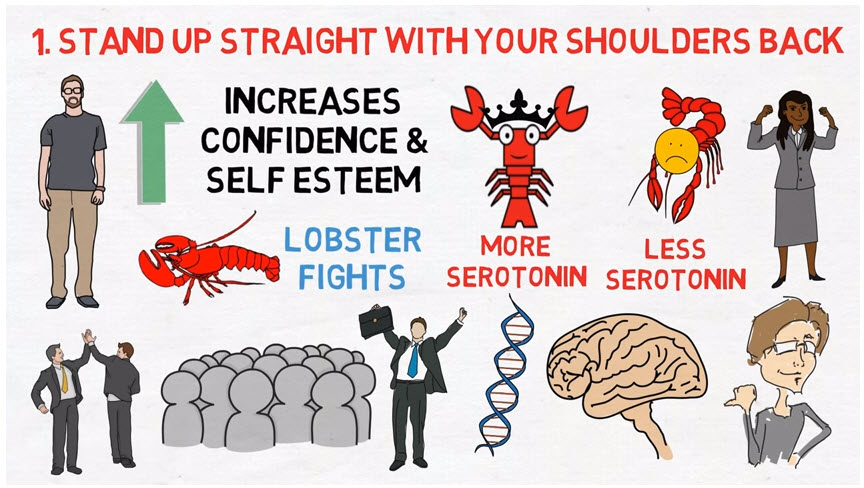 ## Rule No. 1 - **Stand up straight with your shoulders back**  There is little difference between our capacity for destruction and mayhem as there is for greatness. **Awareness doesn't care.** Let go of your nativity that all people are basically good and nobody want to hurt anyone else and that the world is fair. It's not. We are no different than the lobsters... afterall, we evolved from their DNA. The sooner you accept this truth, the more you will start to see it in others. There is a hierarchy and if you are not the alpha lobster/top dog, you are somewhere below. > Here's the good thing about the 80/20 curve and Price's Law... When you start, you are on the curve. You are on the board. And that is all you need to know to get yourself over the hump! This rule is very straight forward and there have been multiple studies that have shown that just correcting your posture increases your confidence and self-esteem. Jordan Peterson gives us a pretty interesting take on this idea he talks about lobsters and how when they win in a fight they stretch out and make themselves produce serotonin. When they lose a fight they become smaller and their serotonin levels go down so lobsters pretty much put themselves in a hierarchy. The lobster that wins most of the fights and has the best posture becomes the top lobster and the lobster with the worst posture becomes the bottom lobster. Our society isn't as simple as lobsters but some of the same brain circuits that govern the lobsters behavior also govern our behaviors. This means that **if you stand up straight with your shoulders back you will feel better and in a way you will feel like the top lobster other people will treat you in a better way and of course your self-esteem will also increases!** ## Rule No. 2: Treat yourself like someone you are responsible for helping.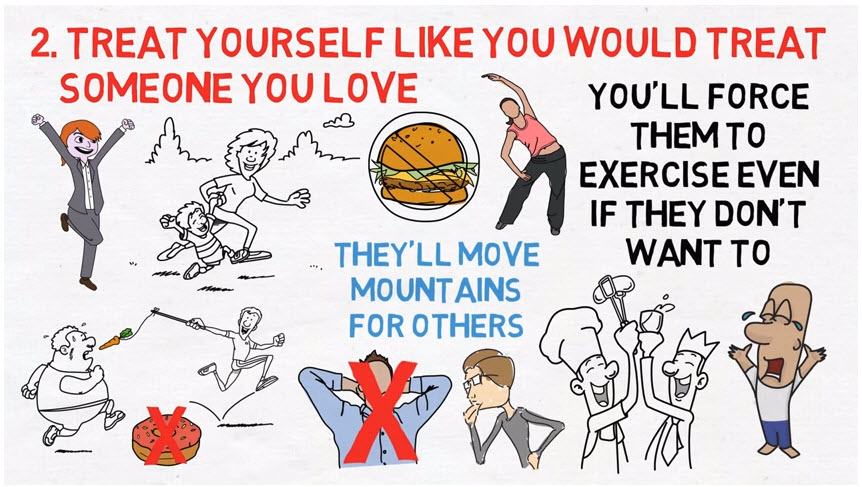 We want the best for the people we love. And since you love yourself, treat yourself like you would someone for whom you love. Think of the extent we go to impress someone we love. As a people pleasure, to please yourself is the greatest gift you can give the life you've been given. I want to eat well because I want the one I love to be healthy and here for a long time. I want to work out and meditate because I know it makes a better person. On the flip side, think of how you treat those you dislike. Are you doing things to yourself that you'd only do to an enemy? ## Rule No. 3 Make friends with people who want the best for you. The people you surround yourself with will determine how you feel about yourself. So if you have toxic friends who don't want the best for you then you're not going to go very far. A good example of bad friends is that when you accomplish something big let's say you get a promotion at work and you go to your friends to tell them about it instead of being happy for you they say something like oh it's not like you're making that much money anyway or they'll say something like well that won't really change your life you should surround yourself with people who genuinely want the best for you and this means that even if you're doing something wrong they'll correct you and if you're winning in life and doing something right they'll be happy for you ## Rule No. 4 > Compare yourself to who you were yesterday, not to who someone else is today. Positive Circle of Friends: Be friends with those who want the best for you. The people around you shape how you feel about yourself. If your friends are toxic and don't support you, it's hard to succeed. Think of a time when something great happened, like getting a promotion at work. When sharing this news with bad friends, they might say things like "you're not making much money anyway" or "that won't change your life." Good friends should be happy for your success and encourage growth. Surround yourself with genuine supporters. They will correct mistakes and celebrate victories in life together with you. Rule #4 is 'Compare yourself with who you were yesterday and not with who someone else is today." Most of us get caught up in comparing ourselves with other people and as a result of this we are never happy. We think oh that guy got better grades than me or this guy is more intelligent than me or this guy makes more money than me. You have to realize there has never been a human being on earth exactly the same as you. Every single human being has had a different life so then how can you expect to have the same outcome as them and how can you compare yourself to them? The only person you should compare yourself to is the person who you were yesterday. If you are always improving and getting even slightly better than you were yesterday then you are on the right track. Learn to love learning about ways to improve yourself. ## Rule No. 5 > Do not let your children do anything that makes you dislike them Rule number five is do not let your children do anything that makes you dislike them now this is a rule for parents and since I'm not a parent I won't get much into this all Jordan talks about in this rule is the fact that you should know how to parent your children in an effective way and make sure that you don't let them do anything that makes you not like them if you don't like the fact that your child starts screaming if he doesn't have his iPad talk to him about it teach him how to be disciplined now I cannot give you parenting advice but all Jordan says is that you should not let this slide because if there is something that makes you not like them then you can be very sure that the same things are going to be the things that are going to bother other people and that can cause a lot of problems for your children. ## Rule No. 6 > Set your house in perfect order before you criticize the world Rule number six is set your house in perfect order before you criticize the world or man. Our society needs this rule right now.
-
All of us are the first people to criticize the government, the institutions for all of our life's problems.
-
I had a friend who would go on and on about how the world was unjust to her. She would tell me about all the ways in which people were bad and about how this world was just a bad place.
-
But think about it this way - what gives you the right to criticize the world for ruining your life if you haven't done everything you can to fix your life?
-
If you haven't put in the effort to make your life better then how can you expect the world to fix everything for you?
-
If you don't like your life right now ask yourself what is it that you can do on your own that can make your life better.
-
Stop thinking you're better than everyone else in this world and actually try to make a difference in your own life at least try to do it for a week, a month before you say something bad about the world.
Rule No. 7
Pursue what is meaningful (not what is expedient) Rule number seven is pursue what is meaningful, not what is expedient. This is something most of us are guilty of.
-
We usually try to do the easy thing, the thing that will give us the quickest results.
-
We try to take the work that makes us the most money, that gets us the most fame, etc.
-
But our brains are wired for meaning. As Viktor Frankl says in Man's Search for Meaning, our brains are meaning making machines.
-
All the money in the world isn't going to help you if your life is meaningless.
-
So always strive to do things which are meaningful.
-
Think more long-term instead of just looking for short-term gratification.
Rule No. 8
Tell the truth – or, at least, don't lie
-
A society works best when everyone is honest with each other.
-
If you're in a relationship and you and your partner don't tell the truth to each other then that relationship is basically meaningless.
-
Trust is very important in human society.
-
When I go out of my house I trust that everyone out there won't try to kill me and that's how I'm able to feel safe and continue to be a productive member of society.
-
It is all of our duties to tell the truth as much as possible.
-
Sometimes when the situation is more complicated than that, at least try not to lie.
Rule No. 9
Assume that the person you are listening to might know something you don't
-
What you don't know is more important than what you do know.
-
Most of us walk around thinking that we know everything we need to, but this is a surefire way to stop learning.
-
With the amount of knowledge that exists in this world, there is no way you can know everything.
-
So whenever you're talking to someone, assume that person knows something you don't.
-
This way you can have a real conversation and actually learn something from them.
-
Instead of always trying to defend your ideas, be open to learning.
Rule No. 10
Be precise in your speech
-
The more precise you can make your speech, the more focused your thoughts will be.
-
If you're not precise in the way you talk or communicate with people, or you're not able to make a point, then you're not going to be successful in society.
-
The people who can make the best arguments and present the best stories win.
-
So you definitely need to learn how to be precise in your speech.
Rule No. 11
Do not bother children when they are skateboarding
-
A lot of people try to stop children when they're playing, especially when they think the game is dangerous.
-
Of course you should stop children from doing something actually dangerous.
-
But sometimes children try things that push their limits out of curiosity and competitiveness.
-
The spirit of pushing ourselves, doing something slightly dangerous, is there amongst all of us.
-
Don't try to stop that in other people. Learn to embrace it.
-
That is where people learn to become extraordinary.
Rule No. 12
Pet a cat when you encounter one on the street
-
This rule is about enjoying the beauty of life.
-
Sometimes there can be terrible tragedies in life and the suffering can get too much to bear. In those moments, you have to find beauty in the little things about life.
-
If a dog wags its tail at you, play with him, give him something to eat, look at the happiness in the little animal's face and learn to be happy yourself.
-
If you're going through rough times, shorten the time frame. Don't think about surviving an entire year, think about making it through the next month, week, day or even hour.
-
When you break it down into manageable time frames, you can get through things you could never have imagined.
NEW
Introductory Notes
Moses comes down the mountain, after a long absence, bearing the tablets inscribed with ten commandments, and finds the Children of Israel in revelry. They'd been Pharaoh's slaves and subject to his tyrannical regulations for four hundred years, and after that Moses subjected them to the harsh desert wilderness for another forty years, to purify them of their slavishness. Now, free at last, they are unbridled, and have lost all control as they dance wildly around an idol, a golden calf, displaying all manner of corporeal corruption.
I've got some good news ... and I've got some bad news," the lawgiver yells to them.
"Which do you want first?"
"The good news!" the hedonists reply.
"I got Him from fifteen commandments down to ten!" "Hallelujah!" cries the unruly crowd.
"And the bad?"
"Adultery is still in." Intolerance of others' views (no matter how ignorant or incoherent they may be) is not simply wrong; in a world where there is no right or wrong, it is worse: it is a sign you are embarrassingly unsophisticated or, possibly, dangerous. But if it's uncertain that our ideals are attainable, why do we bother reaching in the first place? Because if you don't reach for them, it is certain you will never feel that your life has meaning.
And perhaps because, as unfamiliar and strange as it sounds, in the deepest part of our psyche, we all want to be judged We require rules, standards, values --- alone and together. We're pack animals, beasts of burden. We must bear a load, to justify our miserable existence. We require routine and tradition. That's order When the aristocracy catches a cold, as it is said, the working class dies of pneumonia.It's not what we don't know that gets us in trouble. It's what we know for sure that just ain't so. ~ Mark Twain "In my kingdom," as the Red Queen tells Alice in Wonderland, "you have to run as fast as you can just to stay in the same place." No one standing still can triumph, no matter how well constituted. There is very little difference between the capacity for mayhem and destruction, integrated, and strength of character. This is one of the most difficult lessons of life. 12 Rules for Life
RULE 1 / Stand up straight with your shoulders back RULE 2 / Treat yourself like someone you are responsible for helping RULE 3 / Make friends with people who want the best for you RULE 4 / Compare yourself to who you were yesterday, not to who someone else is today RULE 5 / Do not let your children do anything that makes you dislike them RULE 6 / Set your house in perfect order before you criticize the world RULE 7 / Pursue what is meaningful (not what is expedient) RULE 8 / Tell the truth --- or, at least, don't lie RULE 9 / Assume that the person you are listening to might know something you don't RULE 10 / Be precise in your speech RULE 11 / Do not bother children when they are skateboarding RULE 12 / Pet a cat when you encounter one on the street Notes
R U L E 1 STAND UP STRAIGHT WITH YOUR SHOULDERS BACK To stand up straight with your shoulders back is to accept the terrible responsibility of life, with eyes wide open. So, attend carefully to your posture. Quit drooping and hunching around. Speak your mind. Put your desires forward, as if you had a right to them --- at least the same right as others. Walk tall and gaze forthrightly ahead. Dare to be dangerous. Encourage the serotonin to flow plentifully through the neural pathways desperate for its calming influence. Look for your inspiration to the victorious lobster, with its 350 million years of practical wisdom. Stand up straight, with your shoulders back. R U L E 2 TREAT YOURSELF LIKE SOMEONE YOU ARE RESPONSIBLE FOR HELPING You can lead a horse to water, but you can't make him drink It is the drama of lived experience --- the unique, tragic, personal death of your father, compared to the objective death listed in the hospital records; the pain of your first love; the despair of dashed hopes; the joy attendant upon a child's success. Chaos is the domain of ignorance itself. It's unexplored territory. Chaos is what extends, eternally and without limit, beyond the boundaries of all states, all ideas, and all disciplines. It's the foreigner, the stranger, the member of another gang, the rustle in the bushes in the night-time, the monster under the bed, the hidden anger of your mother, and the sickness of your child. Chaos is the despair and horror you feel when you have been profoundly betrayed. It's the place you end up when things fall apart; when your dreams die, your career collapses, or your marriage ends. It's the underworld of fairytale and myth, where the dragon and the gold it guards eternally co-exist. Chaos is where we are when we don't know where we are, and what we are doing when we don't know what we are doing. It is, in short, all those things and situations we neither know nor understand. Order, by contrast, is explored territory. That's the hundreds-of-millions-of years- old hierarchy of place, position and authority. That's the structure of society. It's the structure provided by biology, too --- particularly insofar as you are adapted, as you are, to the structure of society. Order is tribe, religion, hearth, home and country. It's the warm, secure living-room where the fireplace glows and the children play. It's the flag of the nation. It's the value of the currency. Order is the floor beneath your feet, and your plan for the day. It's the greatness of tradition, the rows of desks in a school classroom, the trains that leave on time, the calendar, and the clock. Order is the public façade we're called upon to wear, the politeness of a gathering of civilized strangers, and the thin ice on which we all skate. Order is the place where the behavior of the world matches our expectations and our desires; the place where all things turn out the way we want them to. That journey into darkness and rescue is the most difficult thing a puppet must do, if he wants to be real; if he wants to extract himself from the temptations of deceit and acting and victimization and impulsive pleasure and totalitarian subjugation; if he wants to take his place as a genuine Being in the world. The worst of all possible snakes is the eternal human proclivity for evil.
The worst of all possible snakes is psychological, spiritual, personal, internalץ The line dividing good and evil cuts through the heart of every human being- Aleksander Solzhenitsyn
Question for parents: do you want to make your children safe, or strong?
If there is a rifle hanging on the wall in act one, it must be fired in the next act. Otherwise it has no business being there.
--- Anton Chekhov Only man will inflict suffering for the sake of suffering. That is the best definition of evil I have been able to formulate. We shall not cease from exploration And the end of all our exploring Will be to arrive where we started And know the place for the first time. Through the unknown, remembered gate When the last of earth left to discover Is that which was the beginning; At the source of the longest river The voice of the hidden waterfall And the children in the apple-tree Not known, because not looked for But heard, half-heard, in the stillness Between two waves of the sea. Quick now, here, now, always --- A condition of complete simplicity (Costing not less than everything) And all shall be well and All manner of things shall be well When the tongues of flames are in-folded Into the crowned knot of fire And the fire and the rose are one. ("Little Gidding," Four Quartets, 1943) He whose life has a why can bear almost any how. -Friedrich Nietzsche You need to consider the future and think, "What might my life look like if I were caring for myself properly? What career would challenge me and render me productive and helpful, so that I could shoulder my share of the load, and enjoy the consequences? What should I be doing, when I have some freedom, to improve my health, expand my knowledge, and strengthen my body?" You need to know where you are, so you can start to chart your course. You need to know who you are, so that you understand your armament and bolster yourself in respect to your limitations. You need to know where you are going, so that you can limit the extent of chaos in your life, restructure order, and bring the divine force of Hope to bear on the world. You must discipline yourself carefully. You must keep the promises you make to yourself, and reward yourself, so that you can trust and motivate yourself. You need to determine how to act toward yourself so that you are most likely to become and to stay a good person. It would be good to make the world a better place. Heaven, after all, will not arrive of its own accord. We will have to work to bring it about, and strengthen ourselves, so that we can withstand the deadly angels and flaming sword of judgment that God used to bar its entrance. You could begin by treating yourself as if you were someone you were responsible for helping. R U L E 3 MAKE FRIENDS WITH PEOPLE WHO WANT THE BEST FOR YOU Don't think that it is easier to surround yourself with good healthy people than with bad unhealthy people. It's not. A good, healthy person is an ideal. It requires strength and daring to stand up near such a person. Have some humility. Have some courage. Use your judgment, and protect yourself from too-uncritical compassion and pity. Make friends with people who want the best for you. R U L E 4 COMPARE YOURSELF TO WHO YOU WERE YESTERDAY, NOT TO WHO SOMEONE ELSE IS TODAY Who are you? You think you know, but maybe you don't. You are, for example, neither your own master, nor your own slave. You cannot easily tell yourself what to do and compel your own obedience (any more than you can easily tell your husband, wife, son or daughter what to do, and compel theirs). You are interested in some things and not in others. You can shape that interest, but there are limits. Some activities will always engage you, and others simply will not. You have a nature. You can play the tyrant to it, but you will certainly rebel. How hard can you force yourself to work and sustain your desire to work? How much can you sacrifice to your partner before generosity turns to resentment? What is it that you actually love? What is it that you genuinely want? Before you can articulate your own standards of value, you must see yourself as a stranger, and then you must get to know yourself. What do you find valuable or pleasurable? How much leisure, enjoyment, and reward do you require, so that you feel like more than a beast of burden? How must you treat yourself, so you won't kick over the traces and smash up your corral? You could force yourself through your daily grind and kick your dog in frustration when you come home. You could watch the precious days tick by. Or you could learn how to entice yourself into sustainable, productive activity. Do you ask yourself what you want? Do you negotiate fairly with yourself? Or are you a tyrant, with yourself as slave? When do you dislike your parents, your spouse, or your children, and why? What might be done about that? What do you need and want from your friends and your business partners? How do you need to be spoken to? What do you need to take from people? Consult your resentment. It's a revelatory emotion, for all its pathology. It's part of an evil triad: arrogance, deceit, and resentment. Nothing causes more harm than this underworld Trinity. When you have something to say, silence is a lie. What do you do to avoid conflict, necessary though it may be? What are you inclined to lie about, assuming that the truth might be intolerable? What do you fake? Be cautious when you're comparing yourself to others. You're a singular being, once you're an adult. You have your own particular, specific problems --- financial, intimate, psychological, and otherwise. Those are embedded in the unique broader context of your existence. Your career or job works for you in a personal manner, or it does not, and it does so in a unique interplay with the other specifics of your life. You must decide what to let go, and what to pursue. We cannot navigate, without something to aim at and, while we are in this world, we must always navigate. We live within a framework that defines the present as eternally lacking and the future as eternally better. Perhaps happiness is always to be found in the journey uphill, and not in the fleeting sense of satisfaction awaiting at the next peak. Ask yourself: is there one thing that exists in disarray in your life or your situation that you could, and would, set straight? Could you, and would you, fix that one thing that announces itself humbly in need of repair? Could you do it now? What you aim at determines what you see. Life doesn't have the problem. You do. Our values, our morality --- they are indicators of our sophistication. You cannot aim yourself at anything if you are completely undisciplined and untutored. Pay attention. Focus on your surroundings, physical and psychological. Notice something that bothers you, that concerns you, that will not let you be, which you could fix, that you would fix. You can find such somethings by asking yourself (as if you genuinely want to know) three questions: "What is it that is bothering me?" "Is that something I could fix?" and "Would I actually be willing to fix it?" If you find that the answer is "no," to any or all of the questions, then look elsewhere. Aim lower. Search until you find something that bothers you, that you could fix, that you would fix, and then fix it. That might be enough for the day. "What could I do, that I would do, to make Life a little better?" Aim high. Set your sights on the betterment of Being. Align yourself, in your soul, with Truth and the Highest Good. There is habitable order to establish and beauty to bring into existence. There is evil to overcome, suffering to ameliorate, and yourself to better. Realization is dawning. Instead of playing the tyrant, therefore, you are paying attention. You are telling the truth, instead of manipulating the world. You are negotiating, instead of playing the martyr or the tyrant. You no longer have to be envious, because you no longer know that someone else truly has it better. You no longer have to be frustrated, because you have learned to aim low, and to be patient. You are discovering who you are, and what you want, and what you are willing to do. You are finding that the solutions to your particular problems have to be tailored to you, personally and precisely. You are less concerned with the actions of other people, because you have plenty to do yourself. Attend to the day, but aim at the highest good Compare yourself to who you were yesterday, not to who someone else is today. R U L E 5 DO NOT LET YOUR CHILDREN DO ANYTHING THAT MAKES YOU DISLIKE THEM Disciplinary principle 1: limit the rules. Principle 2: use minimum necessary force. Here's a third: parents should come in pairs. Here's a fourth principle, one that is more particularly psychological: parents should understand their own capacity to be harsh, vengeful, arrogant, resentful, angry and deceitful. Clear rules make for secure children and calm, rational parents. Clear principles of discipline and punishment balance mercy and justice so that social development and psychological maturity can be optimally promoted. Clear rules and proper discipline help the child, and the family, and society, establish,maintain and expand the order that is all that protects us from chaos and the terrors of the underworld, where everything is uncertain, anxiety-provoking, hopeless and depressing. There are no greater gifts that a committed and courageous parent can bestow. R U L E 6 SET YOUR HOUSE IN PERFECT ORDER BEFORE YOU CRITICIZE THE WORLD Clean Up Your Life Consider your circumstances. Start small.
- Aleksander Solzhenitsyn
Question for parents: do you want to make your children safe, or strong?
If there is a rifle hanging on the wall in act one, it must be fired in the next act. Otherwise it has no business being there.
- Have you taken full advantage of the opportunities offered to you?
- Are you working hard on your career, or even your job, or are you letting bitterness and resentment hold you back and drag you down?
- Have you made peace with your brother?
- Are you treating your spouse and your children with dignity and respect?
- Do you have habits that are destroying your health and well-being?
- Are you truly shouldering your responsibilities?
- Have you said what you need to say to your friends and family members?
- Are there things that you could do, that you know you could do, that would make things around you better?
- Have you cleaned up your life?
If the answer is no, here's something to try: Start to stop doing what you know
to be wrong. Start stopping today.
Let your own soul guide you.
Watch what happens over the days and weeks.
When you are at work you will begin to say what you really think.
You will start to tell your wife, or your husband, or your children, or your parents, what you really want and need.
When you know that you have left something undone, you will act to correct the omission.
Your head will start to clear up, as you stop filling it with lies.
Your experience will improve, as you stop distorting it with inauthentic actions.
R U L E 7 PURSUE WHAT IS MEANINGFUL (NOT WHAT IS EXPEDIENT)
Something better might be attained in the future by giving up something of value in the present.
The successful among us delay gratification.
The successful among us bargain with the future.
What's the difference between the successful and the unsuccessful?
The successful sacrifice.
"No tree can grow to Heaven unless its roots reach down to Hell"
--- Carl Gustav Jung
He who contrives, defeats his purpose;
and he who is grasping, loses.
The sage does not contrive to win,
and therefore is not defeated;
he is not grasping, so does not lose.
--- Tao te Ching
Cogito ergo sum (I think, therefore I am)
--- René Descartes
An idea is a personality, not a fact.
When it manifests itself within a person, it has a strong proclivity to make of that person its avatar: to impel that person to act it out.
Sometimes, that impulsion (possession is another word) can be so strong that the person will die, rather than allowing the idea to perish.
"If you are disciplined and privilege the future over the present you can change the structure of reality in your favour."
Each human being understands, a priori, perhaps not what is good, but certainly what is not. And if there is something that is not good, then there is something that is good. If the worst sin is the torment of others, merely for the sake of the suffering produced --- then the good is whatever is diametrically opposed to that. The good is whatever stops such things from happening.
Make that an axiom: to the best of my ability I will act in a manner that leads to the alleviation of unnecessary pain and suffering.
Expedience is the following of blind impulse. It's short-term gain. It's narrow,
and selfish. It lies to get its way. It takes nothing into account. It's immature and irresponsible.
Meaning is what is put forth more powerfully than mere words can express by Beethoven's "Ode to Joy," a triumphant bringing forth from the void of pattern after pattern upon beautiful pattern, every instrument playing its part, disciplined voices layered on top of that, spanning the entire breadth of human emotion from despair to exhilaration.
Meaning is what manifests itself when the many levels of Being arrange themselves into a perfectly functioning harmony, from atomic microcosm to cell to organ to individual to society to nature to cosmos, so that action at each level beautifully and perfectly facilitates action at all, such that past, present and future are all at once redeemed and reconciled.
Meaning is what emerges beautifully and profoundly like a newly formed rosebud opening itself out of nothingness into the light of sun and God.
Meaning is the lotus striving upward through the dark lake depths through the ever-clearing water, blooming forth on the very surface, revealing within itself the Golden Buddha, himself perfectly integrated, such that the revelation of the Divine Will can make itself manifest in his every word and gesture.
Meaning is when everything there is comes together in an ecstatic dance of single purpose --- the glorification of a reality so that no matter how good it has suddenly become, it can get better and better and better more and more deeply forever into the future.
Meaning happens when that dance has become so intense that all the horrors of the past, all the terrible struggle engaged in by all of life and all of humanity to that moment becomes a necessary and worthwhile part of the increasingly successful attempt to build something truly Mighty and Good.
Meaning is the ultimate balance between, on the one hand, the chaos of transformation and possibility and on the other, the discipline of pristine order, whose purpose is to produce out of the attendant chaos a new order that will be even more immaculate, and capable of bringing forth a still more balanced and productive chaos and order.
Meaning is the Way, the path of life more abundant, the place you live when you are guided by Love and speaking Truth and when nothing you want or could possibly want takes any precedence over precisely that.
RU L E 8 TELL THE TRUTH --- OR, AT LEAST, DON'T LIE
A sin of commission occurs when you do something you know to be wrong.
A sin of omission occurs when you let something bad happen when you could do something to stop it.
The former is regarded, classically, as more serious than the latter --- than avoidance. I'm not so sure.
The capacity of the rational mind to deceive, manipulate, scheme, trick,
falsify, minimize, mislead, betray, prevaricate, deny, omit, rationalize, bias,
exaggerate and obscure is so endless, so remarkable, that centuries of prescientific thought, concentrating on clarifying the nature of moral endeavour, regarded it as positively demonic.
This is not because of rationality itself, as a
process. That process can produce clarity and progress.
It is because rationality is subject to the single worst temptation --- to raise what it knows now to the status of an absolute.
There is an old Soviet joke. An American dies and goes to hell. Satan himself
shows him around.
They pass a large cauldron. The American peers in.
It's full of suffering souls, burning in hot pitch. As they struggle to leave the pot, low ranking devils, sitting on the rim, pitchfork them back in. The American is properly shocked. Satan says, "That's where we put sinful Englishmen."
The tour continues.
Soon the duo approaches a second cauldron.
It's slightly larger, and slightly hotter. The American peers in. It is also full of suffering souls, all wearing berets.
Devils are pitchforking would-be escapees back into this cauldron, as well. "That's where we put sinful Frenchmen," Satan says.
In the distance is a third cauldron. It's much bigger, and is glowing, white hot. The American can barely get near it. Nonetheless, at Satan's insistence, he approaches it and peers in.
It is absolutely packed with souls, barely visible, under the surface of the boiling liquid.
Now and then, however, one clambers out of the pitch and desperately reaches for the rim. Oddly, there are no devils sitting on the edge of this giant pot, but the clamberer disappears back under the surface anyway.
The American asks, "Why are there no demons here to keep everyone
from escaping?"
Satan replies,
"This is where we put the Russians. If one tries to escape, the others pull him back in."
Consider the person who insists that everything is right in her life. She avoids
conflict, and smiles, and does what she is asked to do.
She finds a niche and hides in it. She does not question authority or put her own ideas forward, and does not complain when mistreated.
She strives for invisibility, like a fish in the center of a swarming school.
But a secret unrest gnaws at her heart. She is still suffering, because life is suffering. She is lonesome and isolated and unfulfilled. But her obedience and self-obliteration eliminate all the meaning from her life.
She has become nothing but a slave, a tool for others to exploit. She does not get what she wants, or needs, because doing so would mean speaking her mind. So, there is nothing of value in her existence to counter-balance life's troubles. And that makes her sick.
It might be the noisy troublemakers who disappear, first, when the institution
you serve falters and shrinks.
But it's the invisible who will be sacrificed next.
Someone hiding is not someone vital.
Vitality requires original contribution.
Hiding also does not save the conforming and conventional from disease,
insanity, death and taxes.
And hiding from others also means suppressing and
hiding the potentialities of the unrealized self.
And that's the problem.
To say it again: it is the greatest temptation of the rational faculty to glorify its own capacity and its own productions and to claim that in the face of its theories nothing transcendent or outside its domain need exist.
This means that all important facts have been discovered. This means that nothing important remains unknown. But most importantly, it means denial of the necessity for courageous individual confrontation with Being.
What is going to save you? The totalitarian says, in essence, "You must rely on faith in what you already know." But that is not what saves. What saves is the willingness to learn from what you don't know.
That is faith in the possibility of human transformation.
That is faith in the sacrifice of the current self for the self that could be.
See the truth. Tell the truth.
Truth will not come in the guise of opinions shared by others, as the truth is
neither a collection of slogans nor an ideology.
It will instead be personal. Your truth is something only you can tell, based as it is on the unique circumstances of your life.
Apprehend your personal truth. Communicate it carefully, in an
articulate manner, to yourself and others.
This will ensure your security and your life more abundantly now, while you inhabit the structure of your current beliefs.
This will ensure the benevolence of the future, diverging as it might from the
certainties of the past.
The truth springs forth ever anew from the most profound wellsprings of
Being.
It will keep your soul from withering and dying while you encounter the
inevitable tragedy of life.
It will help you avoid the terrible desire to seek vengeance for that tragedy --- part of the terrible sin of Being, which everything must bear gracefully, just so it can exist.
If your life is not what it could be, try telling the truth.
If you cling desperately to an ideology, or wallow in nihilism, try telling the truth.
If you feel weak and rejected, and desperate, and confused, try telling the truth.
In Paradise, everyone speaks the truth. That is what makes it Paradise.
Tell the truth. Or, at least, don't lie.
R U L E 9 ASSUME THAT THE PERSON YOU ARE LISTENING TO MIGHT KNOW SOMETHING YOU DON'T
"The great majority of us cannot listen; we find ourselves compelled to evaluate, because listening is too dangerous. The first requirement is courage, and we do not always have it."
--- Carl Rogers
You remember the past not so that it is "accurately recorded," to say it again, but so that you are prepared for the future.
Stop the discussion for a moment, and institute this rule: 'Each person can speak up for himself only after he has first restated the ideas and feelings of the previous speaker accurately, and to that speaker's satisfaction.'
Your wisdom then consists not of the knowledge you already have, but the continual search for knowledge, which is the highest form of wisdom.
You already know what you know, after all --- and, unless your life is perfect, what you know is not enough. You remain threatened by disease, and self-deception, and unhappiness, and malevolence, and betrayal, and corruption, and pain, and limitation.
You are subject to all these things, in the final analysis, because you are just too ignorant to protect yourself.
If you just knew enough, you could be healthier and more honest. You would suffer less. You could recognize, resist and even triumph over malevolence and evil. You would neither betray a friend, nor deal falsely and deceitfully in business, politics or love.
However, your current knowledge has neither made you perfect nor kept you safe. So, it is insufficient, by definition --- radically, fatally insufficient.
R U L E 10 BE PRECISE IN YOUR SPEECH
All the world's a stage, and all the men and women merely players: they have their exits and their entrances; and one man in his time plays many parts, his acts being seven ages.
--- William Shakespeare
There is a story for children, There's No Such Thing as a Dragon, by Jack Kent, that I really like. It's a very simple tale, at least on the surface.
I once read its few pages to a group of retired University of Toronto alumni, and explained its symbolic meaning.
It's about a small boy, Billy Bixbee, who spies a dragon sitting on his bed one morning. It's about the size of a house cat, and friendly. He tells his mother about it, but she tells him that there's no such thing as a dragon.
So, it starts to grow. It eats all of Billy's pancakes. Soon it fills the whole house. Mom tries to vacuum, but she has to go in and out of the house through the windows because of the dragon everywhere. It takes her forever.
Then, the dragon runs off with the house. Billy's dad comes home --- and there's just an empty space, where he used to live. The mailman tells him where the house went. He chases after it, climbs up the dragon's head and neck (now sprawling out into the street) and rejoins his wife and son.
Mom still insists that the dragon does not exist, but Billy, who's pretty much had it by now, insists, "There is a dragon, Mom." Instantly, it starts to shrink. Soon, it's cat-sized again. Everyone agrees that dragons of that size (1) exist and (2) are much preferable to their gigantic counterparts. Mom, eyes reluctantly opened by this point, asks somewhat plaintively why it had to get so big. Billy quietly suggests: "maybe it wanted to be noticed."
Here's the terrible truth about such matters: every single voluntarily unprocessed and uncomprehended and ignored reason for marital failure will compound and conspire and will then plague that betrayed and self-betrayed woman for the rest of her life. The same goes for her husband.
All she --- he --- they --- or we --- must do to ensure such an outcome is nothing: don't notice, don't react, don't attend, don't discuss, don't consider, don't work for peace, don't take responsibility. Don't confront the chaos and turn it into order --- just wait, anything but naïve and innocent, for the chaos to rise up and engulf you instead.
Say what you mean, so that you can find out what you mean.
Act out what you say, so you can find out what happens. Then pay attention. Note your errors.
Articulate them.
Strive to correct them.
That is how you discover the meaning of your life. That will protect you from the tragedy of your life. How could it be otherwise?
Furthermore, in the absence of agreed-upon tradition (and the constraints --- often uncomfortable; often even unreasonable --- that it imposes) there exist only three difficult options: slavery, tyranny or negotiation.
The slave merely does what he or she is told --- happy, perhaps, to shed the responsibility --- and solves the problem of complexity in that manner.
But it's a temporary solution. The spirit of the slave rebels.
The tyrant merely tells the slave what to do, and solves the problem of complexity in that manner.
But it's a temporary solution. The tyrant tires of the slave.
There's nothing and no one there, except for predictable and
sullen obedience. Who can live forever with that?
But negotiation --- that requires forthright admission on the part of both players that the dragon exists. That's a reality difficult to face, even when it's still too small to simply devour the knight who dares confront it.
Be careful with what you tell yourself and others about what you have done, what you are doing, and where you are going.
Search for the correct words.
Organize those words into the correct sentences, and those sentences into the correct paragraphs.
The past can be redeemed, when reduced by precise language to its essence. The present can flow by without robbing the future if its realities are spoken out clearly. With careful thought and language, the singular, stellar destiny that justifies existence can be extracted from the multitude of murky and unpleasant futures that are far more likely to manifest themselves of their own accord.
This is how the Eye and the Word make habitable order
Confront the chaos of Being.
Take aim against a sea of troubles.
Specify your destination, and chart your course.
Admit to what you want.
Tell those around you who you are.
Narrow, and gaze attentively, and move forward, forthrightly.
Be precise in your speech
R U L E 11 DO NOT BOTHER CHILDREN WHEN THEY ARE SKATEBOARDING
if you cannot understand why someone did something, look at the consequences --- and infer the motivation. --- Carl Jung When someone claims to be acting from the highest principles, for the good of others, there is no reason to assume that the person's motives are genuine. People motivated to make things better usually aren't concerned with changing other people --- or, if they are, they take responsibility for making the same changes to themselves (and first). the fact that power plays a role in human motivation does not mean that it plays the only role, or even the primary role. The most valid personality trait predictors of long-term success in Western countries are intelligence (as measured with cognitive ability or IQ tests) and conscientiousness (a trait characterized by industriousness and orderliness). Entrepreneurs and artists are higher in openness to experience, another cardinal personality trait, than in conscientiousness. But openness is associated with verbal intelligence and creativity, so that exception is appropriate and understandable if only power exists, then the use of power becomes fully justifiable Group identity can be fractionated right down to the level of the individual There are only two major reasons for resentment: being taken advantage of (or allowing yourself to be taken advantage of), or whiny refusal to adopt responsibility and grow up. Assume ignorance before malevolence. R U L E 1 2 PET A CAT WHEN YOU ENCOUNTER ONE ON THE STREET Imagine a Being who is omniscient, omnipresent, and omnipotent. What does such a Being lack? The answer? Limitation. If you are already everything, everywhere, always, there is nowhere to go and nothing to be. Everything that could be already is, and everything that could happen already has. And it is for this reason, so the story goes, that God created man. No limitation, no story. No story, no Being. Being of any reasonable sort appears to require limitation. When you love someone, it's not despite their limitations. It's because of their limitations. Ask, and it shall given to you; Seek, and ye shall find; Knock, and it shall be open unto you: For everyone who asks receives; the one who seeks finds; and to the one who knocks, the door will be opened (Matthew 7:7--7:8)
The Prompts for a Successful Future You
-
What shall I do tomorrow? How will I create the most good possible in the shortest period of time?
-
What shall I do next year? Try to ensure that the good I do then will be exceeded only by the good I do the year after that.
-
What shall I do with my life? Aim for Paradise, and concentrate on today.
-
What shall I do with my wife? Treat her as if she is the Holy Mother of God, so that she may give birth to the world-redeeming hero.
-
What shall I do with my daughter? Stand behind her, listen to her, guard her, train her mind, and let her know it's OK if she wants to be a mother.
-
What shall I do with my parents? Act such that your actions justify the suffering they endured.
-
What shall I do with my son? Encourage him to be a true Son of God.*
-
What shall I do with the stranger? Invite him into my house, and treat him like a brother, so that he may become one.
-
What shall I do with a fallen soul? Offer a genuine and cautious hand, but do not join it in the mire.
-
What shall I do with the world? Conduct myself as if Being is more valuable than Non-Being.
-
How shall I educate my people? Share with them those things I regard as truly important.
-
What shall I do with a torn nation? Stitch it back together with careful words of truth.
-
What shall I do for God my Father? Sacrifice everything I hold dear to yet greater perfection.
-
What shall I do with a lying man? Let him speak so that he may reveal himself.
-
How shall I deal with the enlightened one? Replace him with the true seeker of enlightenment. There is no enlightened one. There is only the one who is seeking further enlightenment. Proper Being is process, not a state; a journey, not a destination. It's the continual transformation of what you know, through encounter with what you don't know, rather than the desperate clinging to the certainty that is eternally insufficient in any case.
-
What shall I do when I despise what I have? Remember those who have nothing and strive to be grateful. Consider, as well, that you may be blocked in your progress not because you lack opportunity, but because you have been too arrogant to make full use of what already lies in front of you.
-
What shall I do when greed consumes me? Remember that it is truly better to give than to receive.
-
What shall I do when I ruin my rivers? Seek for the living water and let it cleanse the Earth.
-
What shall I do when my enemy succeeds? Aim a little higher and be grateful for the lesson.
-
What shall I do when I'm tired and impatient? Gratefully accept an outstretched helping hand.
-
What shall I do with the fact of aging? Replace the potential of my youth with the accomplishments of my maturity.
A life lived thoroughly justifies its own limitations.
-
What shall I do with my infant's death? Hold my other loved ones and heal their pain.
-
What shall I do in the next dire moment? Focus my attention on the next right move.
-
What shall I say to a faithless brother? The King of the Damned is a poor judge of Being.
-
What shall I do to strengthen my spirit? Do not tell lies, or do what you despise.
-
What shall I do to ennoble my body? Use it only in the service of my soul.
-
What shall I do with the most difficult of questions? Consider them the gateway to the path of life.
-
What shall I do with the poor man's plight? Strive through right example to lift his broken heart.
-
What shall I do when the great crowd beckons? Stand tall and utter my broken truths.
Further Reading (or watching)